
Around 8 ane thou one thousand tonnes of plastic is dumped into the world's oceans every unmarried year. Plastic which is unsafe to marine life and, ane time it enters the nutrient chain, unsafe to the wellness of people equally well. This plastic comes from homes across the world. Mismanaged plastic waste materials as well as waste materials which is intentionally dumped enters the world's rivers as well as hence flows into our seas. Studies are instantly showtime to map where this plastic ends upwards as well as where it originates from.
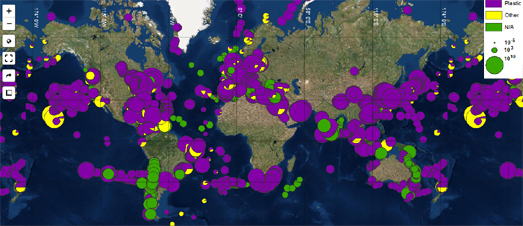
Litterbase is ane arrangement attempting to collate the results of scientific studies researching the levels of plastic pollution flora inward the world's oceans. Currently Litterbase provides a summarized overview of the results from over 1,900 studies into the amount as well as composition of litter as well as its resultant on marine environments. An trial of ane of these summaries is Distribution of Litter Types inward Different Realms, which is an interactive map created from the results of 916 scientific publications on the amount, distribution as well as composition of litter inward the world's oceans.
The map shows the results of hundreds of scientific studies carried out inward specific locations to a greater extent than or less the world. It is not a heatmap of marine pollution to a greater extent than or less the world. It alone shows the levels of pollution inward the areas where studies were carried out. The markers on the map arrive at exhibit the levels of plastic as well as other types of pollution detected at dissimilar locations across the globe. However at that spot are gaps inward seas as well as oceans where lilliputian scientific query has taken place, for trial to a greater extent than or less Africa as well as the Polar regions.

One agency that nosotros tin create total inward these gaps inward our noesis is yesteryear modeling the density of pollution inward the oceans based on the results of scientific studies. Sailing Seas of Plastic is a point density map which shows the estimated concentration of floating plastic inward the oceans based on the results of 24 survey expeditions (2007-2013) as well as on air current as well as body of body of water drift models.
Each point on the Sailing Seas of Plastic map represents twenty kg of floating plastic. According to the map at that spot are 5,250 billion pieces of plastic adrift on the seas of the world. If y'all desire y'all tin equally good overlay the sailing tracks of the 24 survey expeditions on transcend of the point map.

The Seas of Plastic is some other visualization of the floating plastic debris that is polluting the world's oceans which is based on body of body of water drift models. The visualization includes an interactive globe showing the 5 large circulating gyres of plastic inward the North Pacific, North Atlantic, Indian, South Atlantic as well as North Atlantic oceans.
The information for the Seas of Plastic visualization comes from a Lagrangian particle tracking model which mistaken thirty years of input, carry as well as accumulation of floating plastic debris to a greater extent than or less the world. The model tracks the paths of plastic particles from province to sea as well as estimates the relative size of each of the 5 circulatory gyres.
The visualization equally good includes a Sankey Diagram that shows the amount of plastic debris which dissimilar countries contribute to each of these 5 circulating gyres. This diagram reveals that PRC is yesteryear far the biggest polluter of the world's oceans, followed closely yesteryear Europe. The notion that PRC is the source for a large proportion of body of body of water pollution is supported yesteryear the Ocean Cleanup campaign.

The Ocean Cleanup organization believes that betwixt 1.15 as well as 2.41 ane thou one thousand metric tons of the plastic inward the oceans originates from the world's river systems. Two thirds of it from the rivers of Asia. To attention explicate how as well as where plastic ends upwards inward the world's oceans the Ocean Cleanup has released an interactive map, River Plastic Emissions to the World’s Oceans.
This map shows river systems to a greater extent than or less the globe. The predicted input from each river scheme is shown at the coast using scaled circular markers. These predicted inputs are based on a model which looks at population density, waste materials management, topography, hydrography, the locations of dams as well as the reported concentration of plastic inward rivers to a greater extent than or less the world.
You tin larn to a greater extent than most how the plastic y'all identify inward your trash ends upwards inward the world's oceans inward a National Geographic story map. In What Happens to the Plastic nosotros Throw Out National Geographic explains how domestic plastic trash ends upwards polluting a remote isle inward the oculus of the South Pacific. As y'all progress through National Geographic's story a background map of the South Pacific shows the levels of mismanaged municipal plastic waste materials produced yesteryear countries on the Pacific Ocean. Much of this plastic waste materials eventually ends upwards inward the Pacific. Carry on scrolling as well as the map updates to exhibit the levels of plastic waste materials entering the body of body of water from rivers inward Asia as well as North, Central & South America.
National Geographic identifies the Yangtze River equally the most polluted river inward the world. Most of the pollution from the Yangtze eventually ends upwards inward the Pacific yesteryear agency of the East PRC Sea. The background map animates the modeled pathways of marine debris to exhibit how the plastic from the world's rivers ends upwards creating the huge plastic gyres which are polluting our oceans.


